Toccoa Photographer Captures Orionid Meteors and Deep Sky Objects
An October 21 composite image reveals Halley's Comet debris streaking near Orion, with the shower remaining visible to the naked eye until early November.
By Elijah Fitzgerald ·
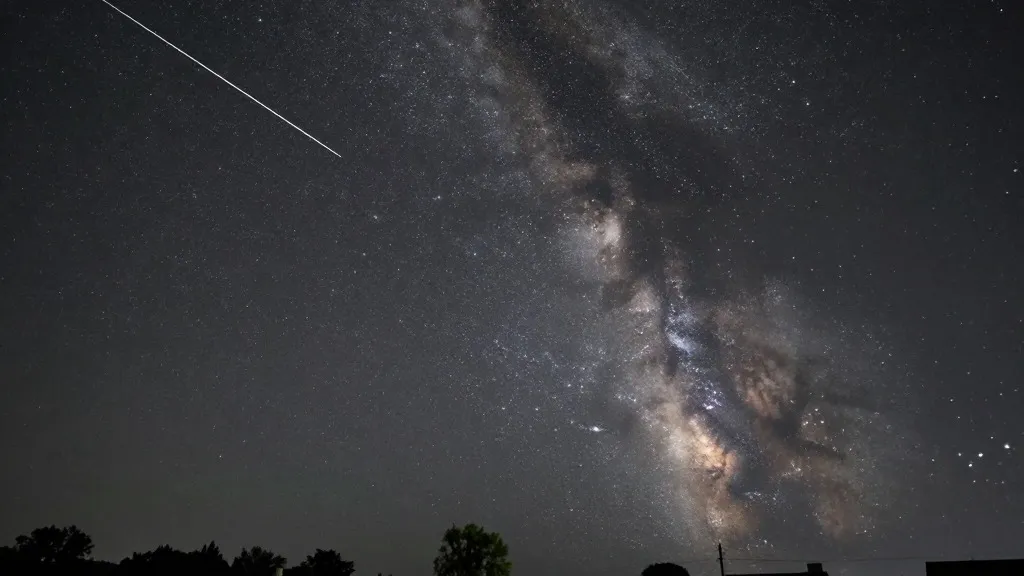
Residents of Toccoa, Georgia, could have witnessed the remnants of Halley's Comet if they had looked up between 3 a.m. and 4 a.m. on Oct. 21. Astrophotographer Tim McCollum captured three distinct meteors during that window. The image serves as a record of the Orionid meteor shower, which is currently building toward its peak activity.
The glowing trails in McCollum's photograph are debris shed by Comet 1P/Halley. The comet itself is located more than 3 billion miles from Earth. Despite that vast distance, the particles left behind in the comet's path continue to burn up in the atmosphere as they enter the Earth's orbit.
McCollum used a Canon EOS Ra camera paired with an RF 28-70 f2.0 lens to capture the scene. He took multiple 30-second exposures while the camera was mounted on a star tracker. The tracker kept the device locked on the shower's radiant, the point in the sky from which the meteors appear to originate. That point is located near Betelgeuse, a red giant star in the constellation Orion.
The final image is a composite created with PixInsight software. Beyond the three meteors, the frame contains several deep sky objects. Orion's Belt appears on the right side of the image, adjacent to the Orion Nebula. The Rosette Nebula, designated as Caldwell 49, is also visible. The dense starfield and dust lanes of the Milky Way's galactic plane run diagonally through the background.
The Orionid shower remains active for the coming weeks. Observers have until Nov. 7 to spot meteors from this stream. The display offers a chance to see the physical connection between a distant comet and the autumn night sky.
A secondary meteor shower, the Taurids, is also active. This shower is caused by debris from Comet 2P/Encke. The Taurid stream can produce large, bright fireballs, often referred to as Halloween Fireballs, which may be visible on the same nights as the Orionids.
McCollum's technique highlights the difficulty of capturing transient events. Meteor photography requires precise timing and equipment stability. The use of a star tracker allowed for long exposures without the stars becoming streaks, a common issue in wide-field astrophotography. The resulting image combines the sharpness of the stars with the motion of the meteors.
The photograph documents a specific moment in the annual cycle of these debris streams. While the comet remains far away, its influence is visible in the frequency and trajectory of the meteors. The image provides a visual reference for the positions of major nebulae and star clusters in the autumn sky.