
Crows make the same calls as primates but finish the work twice as fast
New research reveals that carrion crows utilize identical decision-making logic to monkeys, yet process visual evidence at double the speed.
By Adewale Fletcher ·
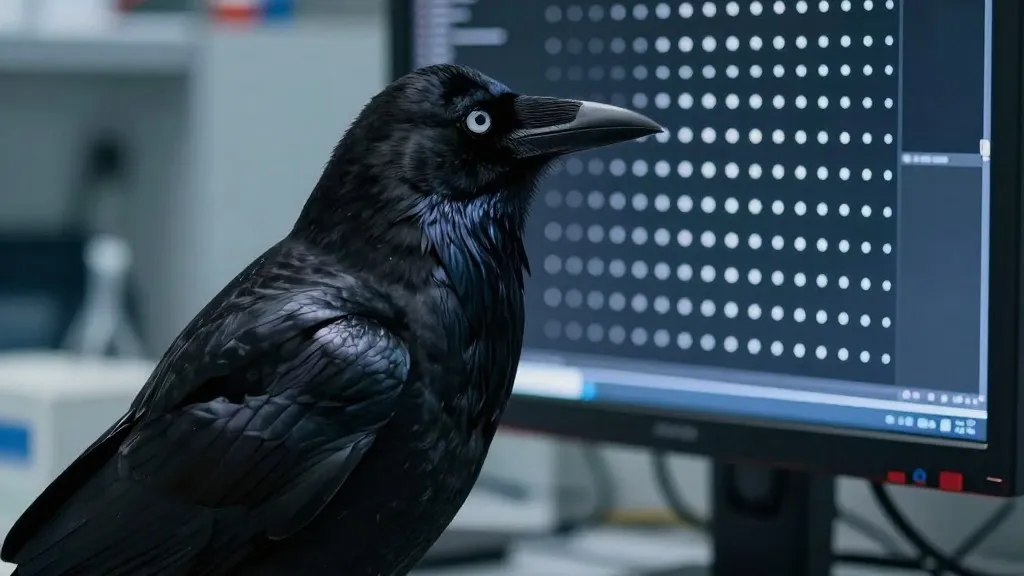
Carrion crows solve complex visual decision tasks with the same mathematical logic used by primates, but they do so at twice the speed. This finding, published in a study released this week, offers a significant update to our understanding of how different brains process information and reach conclusions. The results suggest that the specific hardware of a brain is less important than the underlying algorithms it uses to handle uncertainty.
The core of the research relies on a well-established test known as the random-dot-motion task. In this experiment, a subject observes a cloud of flickering specks that drift weakly in a specific direction. The goal is to determine whether the dots are moving and to identify the direction of that movement. Previous studies on primates demonstrated that neurons in the neocortex accumulate visual evidence over time. As the evidence builds up, the firing rates of these neurons rise until they cross a specific threshold. Once that threshold is met, the animal commits to a choice.
The study addresses a major gap in neuroscience because birds do not possess a neocortex. This structural difference left scientists uncertain about how avian brains encode similar decisions. Andreas Nieder, a neurobiologist at the University of Tübingen, noted that this was the central question driving the research. He explained that the team wanted to understand how a differently organized brain could handle the same cognitive demands.
To investigate this, Nieder and colleague Philipp Schmidbauer conducted experiments on two hand-raised carrion crows. The researchers recorded the birds' brain activity while they performed the task. The crows sat in front of a touch-sensitive monitor that displayed white dots against a black background. A portion of these dots drifted together in one of four directions: left, right, up, or down. The crows indicated their perception of the direction by pecking a target located on the side of the display. A correct selection resulted in a reward of a mealworm.
The experimental setup was designed to be as consistent as possible with previous primate studies. Nieder emphasized the importance of keeping the conditions identical. He stated that the team intentionally wanted to use exactly the same random-dot motion task. The only difference in the procedure was the method of response. While monkeys indicated their decisions through eye movements, the crows had to peck to signal their choice.
The researchers varied the difficulty of the task by adjusting the proportion of dots that moved coherently. At the easiest level, 81 percent of the dots moved in the same direction, making the pattern trivially easy to detect. At the most difficult level, only 3 percent of the dots moved coherently, a signal that was barely distinguishable from random noise. The team also included a condition where zero percent of the dots moved coherently, a scenario in which there was no correct answer.
The data collected from the crows showed that they solved the task using the same fundamental logic as primates. Despite the significant differences in brain organization, the crows relied on comparable mathematical processes to handle the visual evidence. This suggests that the decision-making strategy is a robust solution that can be implemented across different neural architectures.
A particularly striking aspect of the findings is the speed of the crows' processing. The birds reached their decisions twice as fast as the monkeys did in comparable experiments. This efficiency indicates that a brain without a neocortex is not only capable of arriving at similar decisions but can also execute the process with greater rapidity. The study highlights the versatility of avian cognition in the face of complex visual challenges.
This research provides a clearer picture of how non-primate brains manage uncertainty and make choices. By demonstrating that crows use the same decision-making logic as primates, the study challenges assumptions about the necessity of a neocortex for such cognitive tasks. It opens new avenues for exploring how different species optimize their neural resources for speed and accuracy. The work underscores the value of cross-species comparisons in understanding the universal principles of brain function.