Water scarcity caps lunar settlement potential
Researchers estimate that available lunar ice supports small towns for centuries, but megacities for only a century.
By Elijah Fitzgerald ·
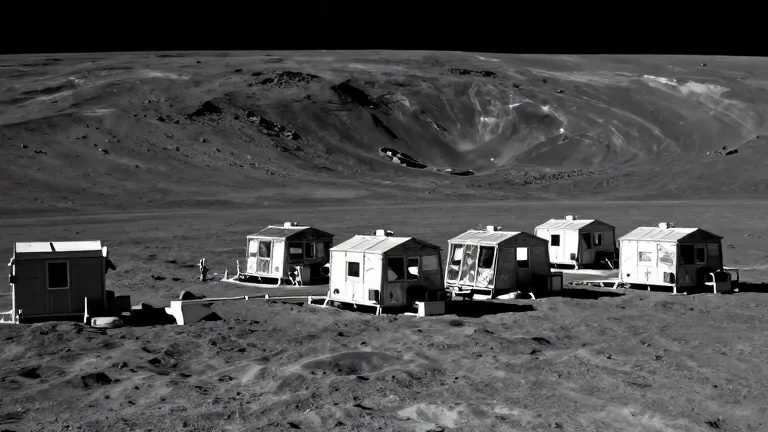
Lunar settlement plans face a hard ceiling due to limited water reserves, according to a new analysis published in Frontiers in Space Technologies. The study suggests that while power requirements for a million-person city can be met, water availability restricts long-term habitability to much smaller populations.
The research responds to recent statements from major aerospace leaders. In February 2026, SpaceX CEO Elon Musk announced a shift in focus toward building a self-growing city on the moon within a decade. Blue Origin CEO Jeff Bezos has separately projected that millions of people will reside in space by 2045. These ambitious timelines prompted Harvard astrophysicist Martin Elvis and Durham University professor Jonathan McDowell to evaluate the physical constraints of lunar habitation.
The pair examined two critical resources: power and water. Their findings indicate that solar and nuclear energy sources are sufficient to support one million residents. Water, however, presents a tighter constraint. Most lunar water is located in permanently shadowed polar regions. The researchers assumed a total supply of one billion tonnes, a figure consistent with current scientific estimates. Under this assumption, a population of one million could survive for approximately 100 years, provided that 98 percent of water is recycled, a rate currently achieved on the International Space Station.
Elvis contextualized the total volume by comparing it to an aquarium the size of Central Park filled until the Statue of Liberty was submerged. He described the supply as a small lake, noting that such a volume cannot sustain a large city for an extended period. A settlement of 10,000 people, by contrast, would remain sustainable for centuries under the same recycling conditions. McDowell noted that expanding beyond this scale would require transporting water to the surface, a logistical challenge that has not yet been solved.
The baseline estimate of one billion tonnes may be optimistic. Elvis suggested the actual total could be 20 or 30 times smaller, with only one-third to one-half of the existing water being recoverable. His conservative estimate places the usable supply at roughly one percent of the original figure. If accurate, the duration for a million-person city would drop from 100 years to one year. The physical state of the water also affects extraction. Western University professor Gordon Osinski noted that satellite data has uncertainties. He suggested the water may exist as sub-millimetre ice crystals mixed into soil, similar to Arctic permafrost, which complicates collection efforts.
The study concludes that while water limits the scale of future lunar cities, it does not prohibit them. McDowell emphasized that the data provides a baseline for planning rather than a barrier to exploration. He stated that the goal is to identify what is feasible before attempting large-scale construction.
More Business · World news · Unethical Practices · Report a business · Got a Story?