
Airlines Scale Sustainable Fuel Use Amid Rising Costs
Production of sustainable aviation fuel nearly doubled in 2025, while hydrogen research accelerates for future long-haul flights.
By Jonathan Hoffmann ·
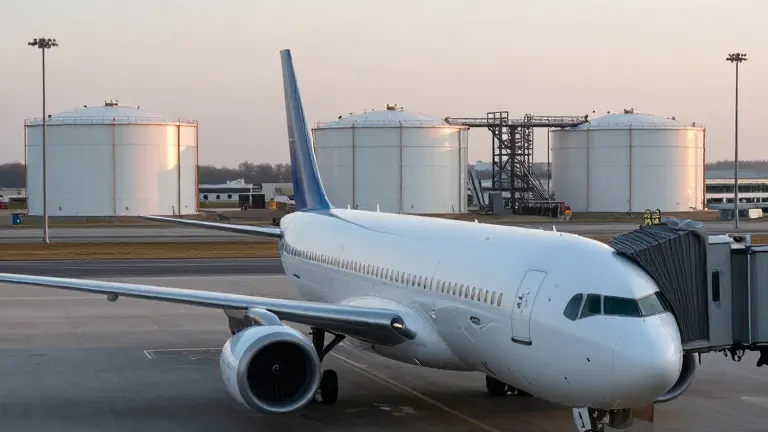
Airlines are expanding their use of sustainable aviation fuel as jet fuel prices rise due to the war in Iran.
The International Air Transport Association, which represents over 370 airlines and handles about 85% of global air traffic, signed a resolution in 2021. This resolution commits members to reach net zero carbon emissions by 2050.
IATA states that sustainable aviation fuel, or SAF, could contribute up to 65% of the emission reductions needed to meet that goal. The fuel is made from sustainably sourced materials such as used cooking oil, biomass waste, and renewable energy.
SAF is a drop-in fuel that blends with conventional jet fuel without requiring changes to aircraft or airport infrastructure. It typically reduces lifecycle carbon emissions by around 80% compared to traditional fuel.
The first commercial test flight using SAF occurred in 2008. The fuel received approval for aircraft operations in 2011.
According to the Air Transport Action Group, global SAF production has roughly doubled each year since 2018. Approximately 2.4 billion liters were produced in 2025, nearly double the output from 2024.
SAF accounted for 0.6% of total airline fuel consumption in 2025, up from 0.3% in 2024. Production capacity is expected to reach 22.5 billion liters by 2030.
Airlines are also investigating hydrogen as a future energy source. IATA reported in early 2025 that the global economy produces about 100 million tonnes of hydrogen annually. Aviation used approximately 280 million tonnes of jet fuel in 2023.
Hydrogen contains no carbon, so it produces no CO2 emissions when burned. IATA notes that hydrogen has three times more energy per kilogram than kerosene-based jet fuel. This allows aircraft to carry less fuel mass, enabling lighter structures and smaller engines.
The US Geological Service published a map showing vast amounts of natural hydrogen may exist below the surface of the contiguous United States. The Energy Department estimates this geologic hydrogen could cost less than $1 per kilogram to produce. This price point is lower than hydrogen made from fossil fuels and one-sixth the cost of hydrogen from wind and solar power.
The World Economic Forum released its Global Aviation Sustainability Outlook 2026 report in March 2026. It noted that airports in Europe, North America, and Asia are testing hydrogen for ground support equipment, airside vehicles, and refueling systems.
IATA estimates that large passenger-carrying hydrogen flights could begin by 2035. A recent report for Advanced Energy and Sustainability Research concludes that decarbonizing aviation will rely on a combination of technologies rather than a single pathway. Hydrogen propulsion, sustainable aviation fuels, and battery-electric aircraft are expected to coexist.
More Business · Unethical Practices · Report a business · Got a Story?