NASA outlines three-rocket test to clear path for 2028 moon landing
The agency detailed a 14-day orbital mission involving SLS, Starship, and New Glenn to validate commercial landers.
By Adewale Fletcher ·
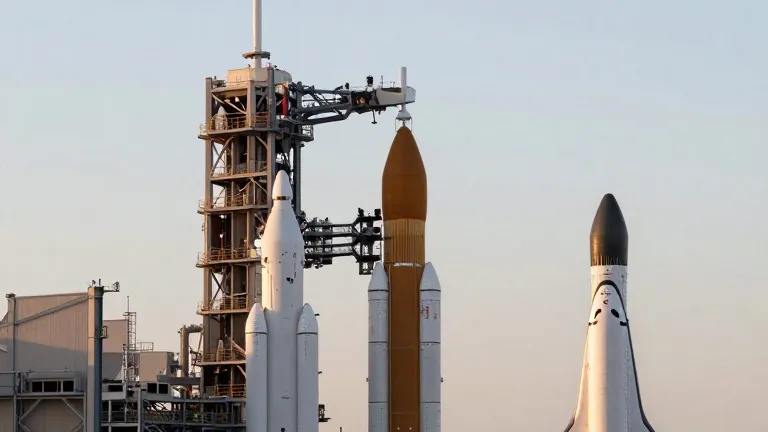
NASA detailed a complex orbital test campaign on October 23 that will involve three separate rocket launches to qualify commercial landers for the 2028 moon landing.
The agency has long faced pressure to finalize the Artemis program schedule while managing costs across its commercial partners. This latest operational plan represents a shift toward a multi-vehicle integration strategy. The mission aims to resolve technical hurdles before committing hardware to the lunar surface.
The sequence begins with Blue Origin's New Glenn rocket launching the Blue Moon lander into low Earth orbit. NASA's Space Launch System (SLS) will follow, carrying four astronauts aboard the Orion spacecraft. The crew consists of NASA's Randy Bresnik, Andre Douglas, and Frank Rubio, along with European Space Agency astronaut Luca Parmitano. SLS will place Orion in a highly elliptical orbit reaching 1,122 miles in altitude before the capsule adjusts to a stable orbit at 345 miles.
The crew will spend two days verifying Orion's systems before docking with Blue Moon on the third day of the mission. They will evaluate the lander's life support and environmental controls at an altitude of 273 miles. SpaceX's Starship is scheduled to launch around the sixth day with a specialized docking adapter. The Starship upper stage will meet Orion on the eighth day for a two-hour encounter. The crew will remain inside Orion during this phase, allowing engineers to gather data on docking forces without the risk of crew transfer.
Following the Starship encounter, the mission will continue for another six to nine days. The nominal duration is 14 days, though the timeline could extend to 17 days. The crew will complete health assessments, technology demonstrations, and survival suit evaluations that were not performed during the April Artemis II flyby. The mission will conclude with a parachute-assisted ocean splashdown.
NASA Administrator Jared Isaacman stated that the agency is preserving options for both commercial partners to maximize readiness for the 2028 landing. He noted that the agency has no intention of discarding a viable path to the moon before data or schedule constraints force a decision. Program manager Jeremy Parsons described the campaign as likely the most complicated launch sequence ever attempted, citing the lunar lander supply chain as a primary challenge. Isaacman said the team is moving with real speed and purpose to address these issues.
NASA has not yet set a firm launch date for the mission. The agency is targeting a summer launch next year, although an internal memo from last month indicated the schedule is currently 90 days behind. Parsons and Isaacman both expressed confidence that the team can work through the remaining technical and logistical obstacles.
More Business · Tech news · Unethical Practices · Report a business · Got a Story?