Russian Tankers Reroute After Icebreakers Fail in Vilkitsky Strait
A two-week delay in July reveals the logistical gaps in Moscow's Arctic trade plans as cargo volumes rise.
By Elijah Fitzgerald ·
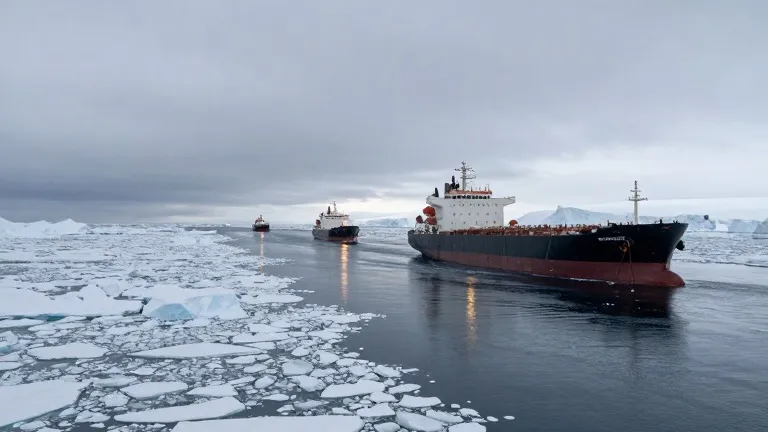
Two nuclear-powered icebreakers could not clear a path for a group of sanctioned Russian tankers stuck in the Vilkitsky Strait in July. The vessels, anchored about 55 kilometers above the Arctic Circle, waited up to two weeks before diverting to an alternate route. Only one tanker managed to pass through the choke point between the Siberian coast and Bolshevik Island during the incident.
The delay contrasts with Kremlin claims that the Northern Sea Route offers a safe and reliable corridor for energy exports. President Vladimir Putin described the route as a path to major markets, noting that 37 million tons of cargo moved along parts of the route in 2025. He predicted that volume would nearly double by 2030. Ksenia Vakhrusheva of the environmental group Bellona said the July episode shows that less ice does not guarantee easier travel, as melting ice can pack tightly in narrow channels and block ships without specialized hulls.
Shipping data indicates a modest but growing flow of Russian oil to Asia. The Norway-funded Center for High North Logistics reported that Russia shipped approximately 2 million tons of crude oil, or 15 million barrels, along the full route by the end of September. Reuters cited trading data showing the total reached about 20 million barrels by mid-October. This represents a 50 percent increase from 2025 levels, though it accounts for only about 1 percent of Russia's total seaborne oil exports. Tomas Alexa of Ambrey called the increase a surge from a low base.
Western sanctions complicate Russia's ability to maintain its Arctic fleet. Alexa noted that spare parts and construction materials often require routing through third countries. Repair services previously provided by Norwegian, Danish, and Dutch firms are no longer available to Russian vessels. Other nations are beginning to test the route. South Korea reported on October 22 that its first container ship had used the Northern Sea Route, citing difficult conditions including large ice floes. China also completed several scheduled container voyages to Europe for the first time this year.
Catherine Sendak of the Center for European Policy Analysis noted that Russia treats much of the Arctic as an inner waterway, leaving questions about tolls and services for foreign ships. She suggested Moscow might limit access for other actors. Security concerns are rising alongside trade activity. Kaja Kallas, the EU foreign affairs chief, described the region as a front line of global power competition on October 21. NATO launched the Arctic Sentry mission in February, and the United States announced plans last month to expand its military presence in Greenland. Vakhrusheva added that oil degrades slowly in cold temperatures and can spread over ice, while Russia publishes no official data on incidents in the remote area.