Four Moscow Airports Shut for Nine Hours in October Drone Strikes
Ukrainian drone activity has triggered daily airspace closures at Russia's main hubs, a trend military analysts say is likely to persist.
By Adewale Fletcher ·
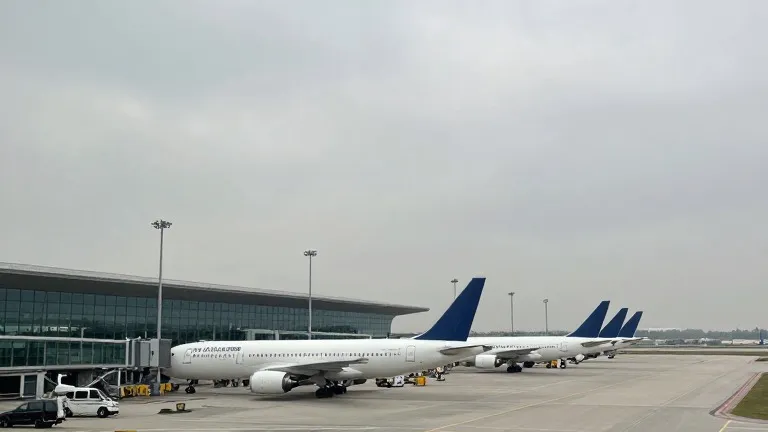
Four major airports in the Moscow region have suspended operations almost every day in October 2026. The closures, some lasting up to nine hours, result from Ukrainian drone activity that forces Russian aviation authorities to invoke strict safety protocols. This pattern of disruption has intensified over recent months, affecting both domestic and international travel schedules.
The situation stems from a strategy outlined by Ukrainian President Volodymyr Zelenskyy in early September. He declared that Ukraine would seek to cut off the airspace around Moscow and other Russian destinations. Addressing airlines and insurers, Zelenskyy stated, "Russian airspace will become completely unsafe." The following day, Ukraine sent a similar warning to the International Civil Aviation Organization. Ukraine has kept its own airspace closed since Russia's full-scale invasion began in February 2022.
Russian aviation authority Rosaviatsiya manages the response through a procedure known as the "carpet" protocol. This rule mandates immediate airspace closure if an aircraft violates Russian airspace, weapons are used, or unidentified objects appear in the sky. Oleksandr Laneckij, chief executive of Friendly Avia Support, explained that the protocol treats every drone as a military threat. He compared the current disruption to the impact of Yemen's Houthis on Saudi airspace, noting that Ukraine's military capabilities exceed those of the Houthis.
Jan Matvejev, a military analyst, argued that Ukraine can severely disrupt traffic around Moscow without fully closing Russian airspace. He noted that triggering the protocol requires only simple drones, which Ukraine's arms industry can produce in the hundreds per day. Simon Shuster of The Atlantic wrote in October that Ukraine's efforts are "just getting started." Matvejev added that Russian air defenses are not fully effective, stating that if Russia could easily shoot the drones down, it would have done so by now.
Experts warn that the reliance on air defense systems poses risks to civilian flights. Laneckij said Russia might lower the threshold for declaring the protocol, increasing the danger of incidents similar to the December 2024 crash of an Azerbaijan Airlines flight. Investigators determined that a Russian air-defense missile, fired to counter drones, hit that aircraft, killing 38 people. Matvejev stated that little has changed in Russia's air-defense protocol since that event.
Matvejev explained that while machine guns pose low risks to aircraft, missiles present a different danger. Defects in mass-produced missiles could send one toward a nearby airliner. He noted that drones need no explosives to cause harm, as a collision can be serious. A drone traveling from Ukraine to Moscow must be large, weighing dozens of kilograms. Other locations have also seen impacts, including a drone attack on Pskov airport in summer 2023 and debris falling on Sochi airport earlier this month.
Laneckij said foreign airlines will decide whether to continue flying to Russia based on the military threat, demand, and insurance costs. If insurers rate the risk as very high, premiums could rise sharply, driving up ticket prices. Competition in Russia's aviation market has already shrunk as many airlines went out of business, increasing demand for seats on remaining foreign carriers. He summarized the decision factor as the price airlines must pay for the danger faced.