Rivian buys UK unit to build 3D street tests
The 15-person team will convert daily customer driving footage into digital environments to train autonomous vehicles.
By Elijah Fitzgerald ·
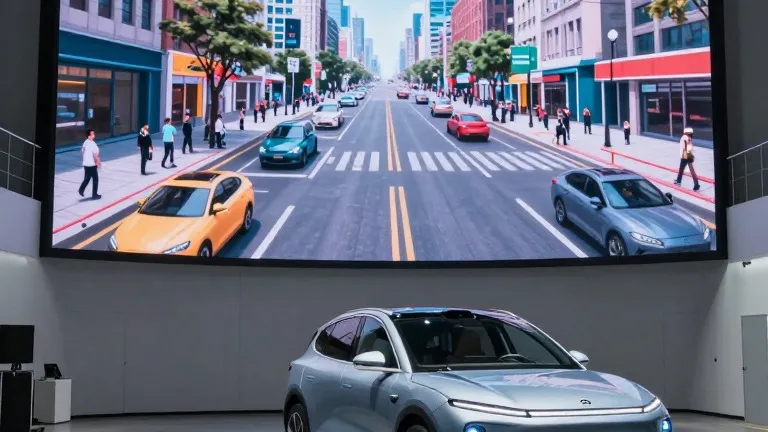
Rivian has purchased Third Dimension, a 15-person startup based in the United Kingdom, to accelerate the development of its self-driving software. The acquisition allows the electric vehicle maker to transform real-world driving footage into three-dimensional test environments. This process enables engineers to simulate rare and complex traffic scenarios without waiting for them to occur on actual roads. Rivian did not specify the financial terms of the deal, which was first reported by TechCrunch.
The new unit joins Rivian's autonomy and AI group under James Philbin. Most of the acquired staff remain in London, which increases Rivian's physical presence in the UK. Philbin stated that simulation is central to training and validating the company's autonomous systems. He noted that Third Dimension has created technology that converts real-world data into detailed 3D environments.
The approach relies on data from Rivian owners who opt into camera sharing. The fleet sends back more than 400,000 driving sequences daily. While most of this data consists of routine driving, the specific incidents that challenge autonomous systems are infrequent. Examples include a mattress in the fast lane, a police officer waving traffic through a red light, or a child running between parked cars. Engineers can now recreate these scenes digitally and adjust variables to test system responses.
Third Dimension was founded in 2024 by Tolga Kart and Piotr Sokólski. Kart previously worked on Tesla's Autopilot simulation and led engineering at Parallel Domain. Sokólski spent four years at Wayve building photorealistic neural simulators for self-driving cars. The startup raised a $7 million seed round led by Felicis in October 2024. It originally targeted game studios, film producers, the US military, and autonomous vehicle companies as customers.
Other automakers are pursuing similar simulation strategies. Waymo unveiled its Waymo World Model in February, which generates scenarios based on Google DeepMind's Genie 3 technology. Tesla has also demonstrated a neural world simulator for its Full Self-Driving software. These efforts aim to prepare vehicles for conditions they have not yet encountered in the field.
Financial stakes are rising as Rivian prepares for robotaxi deployment. In March, Uber agreed to invest up to $1.25 billion in Rivian. Of that amount, only $300 million is paid upfront. The remaining funds are tied to specific autonomy milestones, starting with 10,000 driverless R2 vehicles operating on Uber's network in San Francisco and Miami by 2028.
Consumer timelines for Rivian's autonomous features have shifted recently. The point-to-point driving feature is scheduled to reach a small group of invited Autonomy+ owners later this year. These testers are required to sign nondisclosure agreements. The company has also adjusted its target for eyes-off driving, which CEO RJ Scaringe originally promised for 2026, to 2027. Level 4 capability is planned for 2028 on the Gen 3 hardware.
More Business · Tech news · Unethical Practices · Report a business · Got a Story?