Manila crowds honor dead with flowers and family meals
Thousands of Filipinos visited cemeteries on Sunday for Undas, a tradition that blends Catholic rites with pre-colonial ancestor veneration.
By Jonathan Hoffmann ·
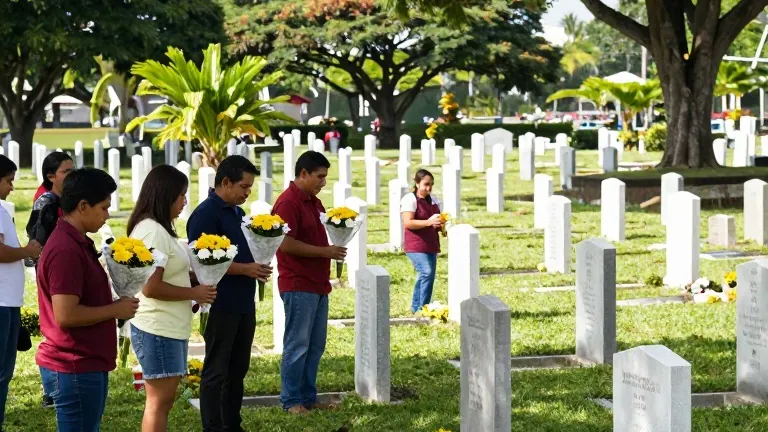
Lorita Santos walked through the cemetery gates on Sunday with flowers in hand.
She was one of thousands of Filipinos who traveled to burial sites across Manila to mark All Saints' Day. The local term for the holiday is Undas, a word derived from the Spanish honras, which translates to honors.
The date falls on Nov. 1, followed by All Souls' Day on Nov. 2. Families use this time to visit the graves of relatives who have died. Santos visited the resting places of her father and three other family members. Her group placed flowers and lit candles at the headstones. They also prayed and shared snacks together.
Santos said the visits allow her family to keep memories alive. She recalled how her father gave small gifts to his children and grandchildren every payday. "We will never forget that," she said. Santos grew up accompanying her relatives to their graves, a practice she now teaches to her own kids. She wants to ensure they understand the tradition so they know how to proceed if she passes away.
Nestor Castro, an anthropology lecturer at the University of the Philippines Diliman, explained that ancestor veneration predates Spanish colonization. Before the 1565 arrival of the Spanish, Filipinos honored ancestral spirits called anito by offering food and other gifts. These practices were not tied to a specific calendar date but formed part of a long-standing cultural custom.
The tradition evolved after the Spanish introduced Catholicism. Some religious practices may have originated in Mexico, a country with historical ties to the Philippines through the Manila-Acapulco galleon trade. Both nations now share similar customs for honoring the dead. In Mexico, families often spend time at graves or build home altars decorated with marigolds, music, and food.
Castro noted that these gatherings strengthen family bonds. In Filipino culture, funeral wakes often wait for distant relatives to arrive before burial takes place. "That's when family reunions occur. It's a binding event," he said. During Undas, families often share sticky rice cakes. The sticky texture symbolizes the bonds between relatives. "These events foster and solidify kinship relationships," Castro said.
Mike Mamaril, a 42-year-old school maintenance employee, visits his parents' graves annually. He said he makes time for the trip even though he rarely gets another chance to go. The visit serves as a reminder of his childhood. "We always talk about who among us got scolded the most," Mamaril said.